The man most likely to lose his erection tonight is often the one whose body works perfectly. He gets hard on his own without thinking about it. He wakes up with erections. He has no trouble with a fantasy. Then a real partner is in the room, and within seconds, nothing.
That's sexual performance anxiety, and it's far more common than the silence around it suggests. Urologists and sex therapists describe it as one of the most frequent reasons younger men seek help for erection problems, and in most of those cases the plumbing is fine. What's misfiring is the fear response.
The good news is that a fear response follows rules, and once you know the rules you can stop playing into them. Here's how to overcome performance anxiety in bed, step by step.
First, rule out the body
Start with one honest question: do your erection problems happen everywhere, or only with a partner?
If you get erections alone, in your sleep, or while fantasizing, and they fade only during partnered sex, the pattern points strongly to anxiety. If the problem happens in every situation, including by yourself, see a doctor before anything else. Erectile trouble can be an early signal of circulation, hormone or other health issues, and that deserves a real medical workup.
For the men who fall into the first group, which is the group this article is for, the rest of the plan applies.
Understand the loop you're stuck in
Performance anxiety works like a circuit. You worry about losing your erection. The worry makes you watch yourself. Watching yourself pulls attention away from pleasure. Without pleasure, the erection fades. The fade confirms the worry, and the next encounter starts with even more of it.
Sex therapists have a name for the middle of that circuit: spectatoring. Instead of participating, you become an observer of your own body, checking firmness, timing and her reaction like gauges on a dashboard. Arousal can't survive that kind of surveillance.
Underneath it is basic physiology. Your nervous system has a protective mode and a relaxed, pleasure-oriented mode, and erections depend on the second one. When your brain decides the bedroom is a place where you might be embarrassed or judged, it shifts into protection. Desire is still there. It's simply been overruled.
Stop trying to force it
This is the step most men get backwards. Their instinct is to fight harder: concentrate, try a breathing technique, will themselves calm. Every one of those moves tells the brain that something dangerous is happening, and the brain responds by turning the alarm up.
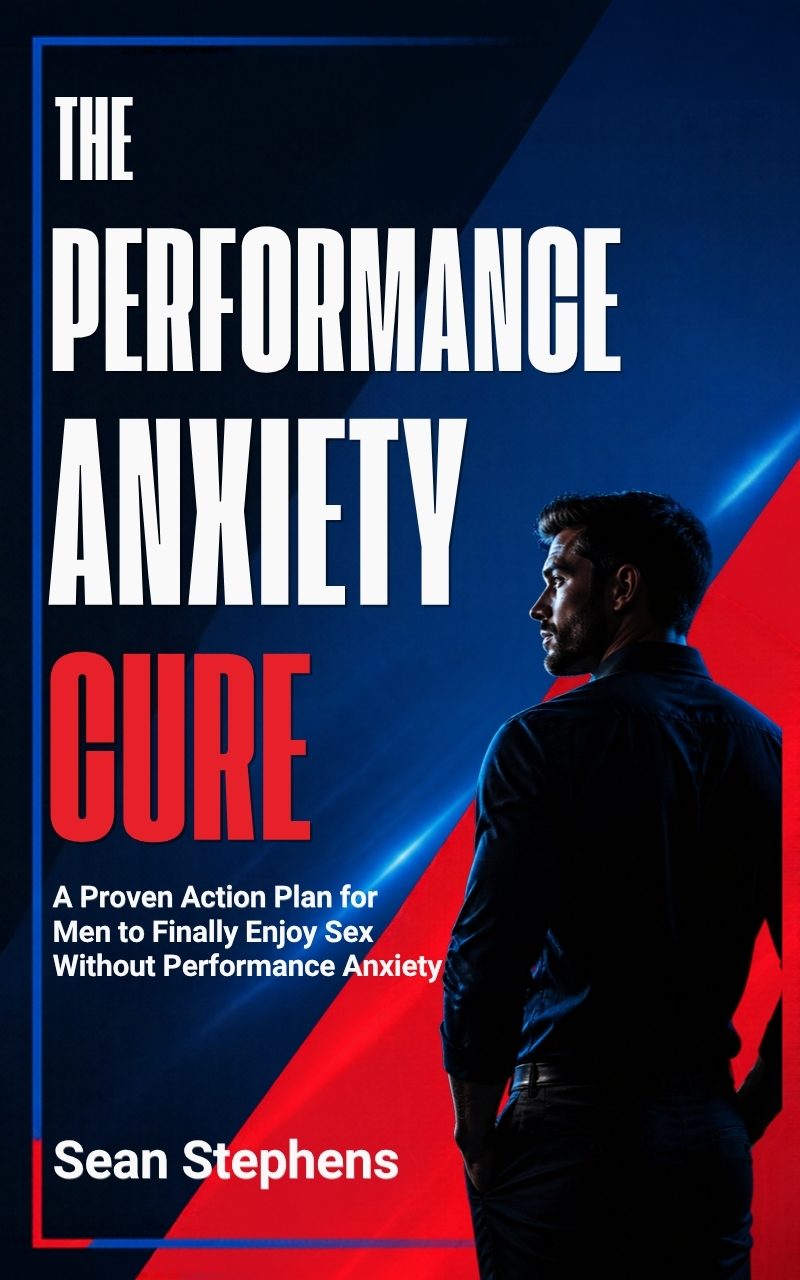
In The Performance Anxiety Cure, Sean Stephens opens with a line that sounds like a contradiction: there is no cure. His point is that performance anxiety isn't something you remove with effort. It fades when you stop feeding it. The effort is the fuel.
So the goal shifts from "make the fear go away" to "build situations where the fear has nothing to grab onto." That's what the next steps do.
Say one honest sentence before anything starts
Silence is the single biggest amplifier. If you lose your erection without saying anything, your partner almost never concludes that you're nervous. She concludes that you're not attracted to her, and the situation gets heavier for both of you.
Head that off early with something short and casual:
"Sometimes it takes me a little while to get going with someone new. I'm really into this, so if it takes a minute, just ignore it."
That one sentence does a remarkable amount of work. She stops watching you for clues. She doesn't take it personally. The "you only get one shot" pressure disappears, and with it, much of the fear. Many men find that saying it makes it far less likely to happen at all.
Lower the stakes on purpose
Stephens calls a version of this the Fail On Purpose reset. Instead of walking in determined to perform, you walk in fully accepting that you might not get hard tonight, and you're fine with that. You're there to enjoy kissing, touching and closeness.
It sounds like giving up. In practice, it removes the test. When there's no test, there's nothing to fail, and the nervous system relaxes enough for arousal to show up on its own. Men are often surprised by how quickly an erection arrives once they stop needing one.
Put your own pleasure first
Anxious men tend to treat sex as a job: satisfy her, prove yourself, get it right. That mindset keeps your attention on outcomes instead of sensation, and sensation is what drives arousal.
Shift your focus to what feels good to you. Touch her in ways you enjoy. Say what you like out loud, which keeps you in the moment. Slow foreplay down and treat it as the main event rather than a warm-up. Being soft for a while during it is completely normal, and most partners care far more about your presence than your erection.
This isn't selfish. Your enjoyment is the foundation hers gets built on, and a man who is truly turned on is more connected and more attractive than one running through a checklist.
Shrink the high-pressure window
Many men notice that once intercourse begins, the anxiety evaporates. The danger zone is the short stretch right before it: repositioning, the pause between foreplay and sex, reaching for a condom. Those gaps hand your mind time to ask "what if I lose it?"
Plan around them. Keep transitions short and simple. Let your partner take the lead on positioning so you can stay in the sensation instead of managing logistics. Keep a condom open and within reach so protection doesn't become a long, distracting pause. Safer sex stays non-negotiable. The aim is to keep it from turning into an ambush.
Skip the quick fixes
NoFap streaks, kegels, herbal supplements and diet tricks all share one flaw: they target a body that already works. If you can get hard alone, a pill from the supplement aisle won't change how your brain reacts to a partner. Worse, when these fixes fail, men tend to decide something is deeply wrong with them, which adds a new layer of fear.
Prescription medication is a different conversation, and one to have with a doctor. Used with medical approval, it can give an anxious man one experience without the fear in charge, which can be enough to rewrite the story his brain tells him. The Performance Anxiety Cure covers a structured way to use it as temporary support and then step away from it.
Expect progress you can't feel
The last piece is patience of an unusual kind. You won't notice performance anxiety leaving. There's no day where you feel it improve. What happens is that good experiences stack up, the fear crosses your mind less often, and one day you realize you haven't thought about it in weeks.
That's the real finish line. Not beating the anxiety, but becoming someone who doesn't carry it anymore.
The short version
- Rule out physical causes if problems happen even when you're alone.
- Recognize the loop: worry, self-watching, lost arousal, more worry.
- Stop fighting the fear. Effort feeds it.
- Tell your partner, casually, before anything starts.
- Remove the test by accepting that tonight doesn't have to go perfectly.
- Focus on what feels good to you.
- Keep the transitions short and planned.
- Talk to a doctor before using any medication.
Each of these gets its own chapter, with scripts and real-world examples, in The Performance Anxiety Cure. If you want the full plan in one place, it's the fastest way to get there.